Page 2
Deciduous Trees For the Eastern U.S.
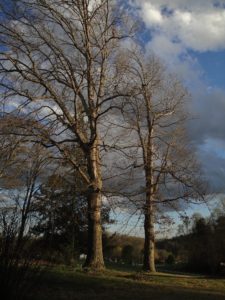
Some of the magnificent white oak trees on the northern NC property.
Here’s a partial list of native and non-native trees that support wildlife. Large deciduous shrubs can substitute for trees in smaller spaces. Many other species might suit your purpose, so visit a few nurseries to see what’s available.
Most trees are sold in large plastic nursery pots, although you might also see freshly dug trees with their roots wrapped in burlap (“b&b”, or balled and burlapped).
- American hop hornbeam (Ostrya)
- basswood (Tilia)
- birch (Betula)
- black gum (Nyssa)
- Carolina silverbell (Halesia)
- chaste tree (Vitex)
- cherry and plum (Prunus)
- crabapple (Malus)
- crape myrtle (Lagerstroemia)
- dogwood (Cornus)
- franklin tree (Franklinia)
- fringe tree (Chionanthus)
- hornbeam (Carpinus)
- magnolia (Magnolia)
- maple (Acer)
- oak (Quercus)
- poplar, cottonwood (Populus)
- redbud (Cercis)
- serviceberry (Amelanchier)
- sourwood (Oxydendrum)
- willow (Salix)
- winterberry (Ilex verticillata)
- witch hazel (Hamamelis)
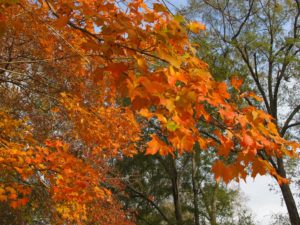
Native red maple can have yellow, orange, or red fall color.
Most of the trees listed above have small- or medium-sized species or varieties. Compare suitability of native and non-native species within the genus. The familiar weeping willow, for example, is non-native and can pose problems when planted near underground pipes. But smaller native willows behave better and host a large number of moths and butterflies.
Research disease resistance, flowers for pollinators, fruits for animals, sun or shade preferences, and soil types. Consider planting species that drop excessive amounts of fruit, acorns, or seedpods farther from the house and paved surfaces.
Also look into the tree’s habit of growth. A specimen with horizontal branches softens the strong vertical lines of a house. Pay close attention to utility poles and wires. Don’t plant trees near them that the utility company will butcher in future years.
Trees with invasive surface roots should be reserved for areas far from structures, pipes, and vegetable gardens. Find out from your town how close to the street or the property line you’re permitted to plant trees. Don’t forget to call 8-1-1 to locate underground utilities before digging.
Chionanthus, the fringe tree (photo, below), is a beautiful bloomer for gardens. This multi-stem plant has 2 species commonly available (C. virginicus, C. retusus), one native and the other from Asia. Male plants have larger flowers, but females set deep blue fruits for birds. The plants, however, are rarely sexed at the nursery.
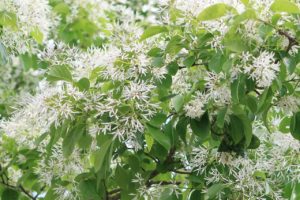
Fringe tree.
The Hollies
Gardeners have planted hollies in gardens for centuries. We can choose among deciduous and evergreen species.
 The hollies (Ilex spp.) are another genus of primarily dioecious (Latin for “two houses”) plants that fruit on female plants. They ordinarily require a male plant, or pollenizer, to set fruit, although holly pollenizers (the males) themselves do not set fruit. Modern breeding techniques have yielded several cultivars that can make berries without pollination.
Ask your nursery salesperson for specifics regarding the need for pollenizers and how close they should be planted to female hollies. Choose the male hollies carefully; they must be closely related to the female holly and bloom at the same time. Holly flowers are often nicely fragrant, and the bees love them! Just don’t shear them off after the buds have formed. Pruning should be minimal if you want flowers and fruits. And bees.
The Curious Case of Crape Myrtle
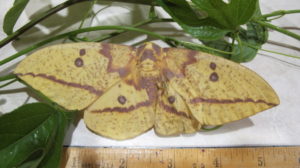
The Imperial moth.
Lagerstroemia indica is an extremely popular landscape tree or shrub in USDA zones 7-9. Crape myrtle, from China and Korea, was first introduced to the southeastern U.S. over 200 years ago. Adapting readily to our hot, humid summers and sometimes drought, it blooms for months despite the adversity.
What makes this non-native plant peculiar is a native moth’s preference for its leaves even when offered a multitude of its local favorites. Last year, I raised caterpillars of the huge Imperial moth. They went for the crape myrtle every time, ignoring all the others. Unless female moths instinctively target this species to host their young, the caterpillars will not likely eat these trees to the bone any time soon.
Several songbirds, including American goldfinches and juncos, feed on the seedpods.
Evergreens
You might prefer an evergreen specimen instead of a deciduous tree that drops its leaves in autumn. Look into arborvitae, chamaecyparis, hemlock, certain holly species, juniper, pine, rhododendron, spruce, and yew. Consider the shade evergreens will cast in winter, and whether sunlight might be blocked from entering windows or melting ice on the driveway.
Although not all those evergreens are native to this part of the country, they make suitable nesting places and provide shelter in inclement weather. A dense border of evergreens can block fierce winter wind for a considerable distance downwind.
Soon after moving into the Maryland house in the 1980’s, I planted a chamaecyparis with deep green whorled foliage. Although it was supposed to get only 6′ tall according to the nursery, it grew to about 20′, when it was cut down by the people who bought the house from me. I left it in the front yard because birds raised a few families among its evergreen branches every year. And it looked gorgeous in the snow.
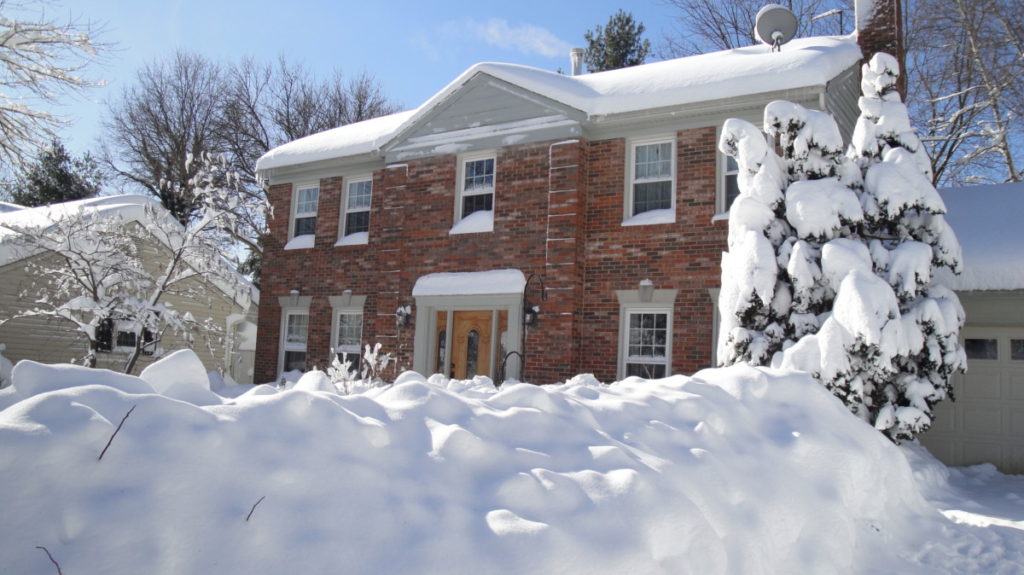
Chamaecyparis on the right, after the 2010 blizzard. Sourwood on the left.
Good Looks
If you’re landscaping purely for aesthetics, plant a tree with characteristics that appeal to you. Besides, all trees provide cover and nesting opportunities, even if they’re passed up by caterpillars.
Perhaps elsewhere you could grow perennials that offer food to wildlife. Planting a bed of milkweeds among the shrubs, for example, will help the monarch butterflies (photo, below).
While you might not consider insects important in your landscape, and, in fact, have invested considerable time and expense eradicating them, they are primary links in the food chain. A healthy landscape hosts a complex assortment of insects and animals. And with the rate at which natural habitats are losing out to development, it’s no wonder we see fewer ladybugs, butterflies, and songbirds in our neighborhoods.
Creating welcoming landscapes provides resting places for migrating birds. But they need natural corridors all along their path in order to find food and perching opportunities. We can help by planting at least part of our property with them in mind—every one of us! Provide food, water, and trees to rest in, and you might catch a glimpse of a bird you’ve never seen before. (***Update***: one morning in early May, I caught a glimpse of a rose-breasted grosbeak, a blue grosbeak, and a [new to me] golden-crowned kinglet at the feeder. 5/6/2026)
I urge you to adopt a new attitude toward welcoming wildlife. You don’t need 10 acres to make a difference. A well-planted fraction of an acre will encourage many kinds of insects and animals to reside there. If you let them eat your plants and the sprayer hasn’t been used once this year, well done!
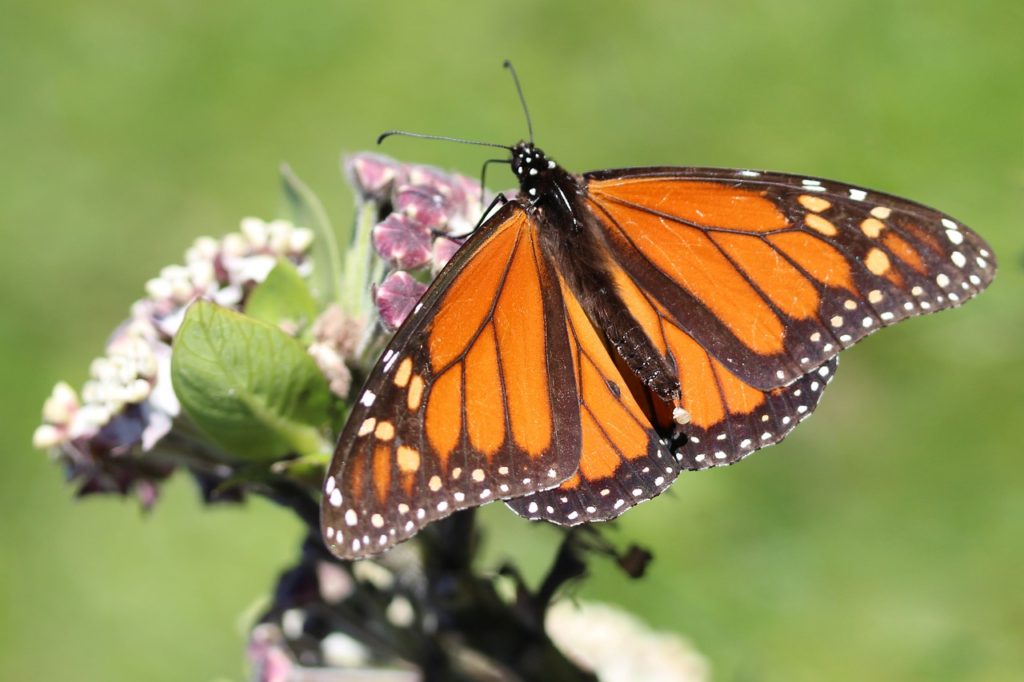
Monarch butterfly on milkweed.
Before Planting Trees
Let’s imagine a 2-story house and an appropriately proportional medium-sized tree. Your landscape plan calls for locating this tree off the southwest corner in the front of the house.
To prevent branches from rubbing against the siding in the future, you’ll want to plant the tree far enough from the house. Divide the mature spread of the tree by 2. Because plants tend to grow larger than the dimensions printed on the label, add a few feet to the measurement. So, a tree with a mature spread of 25-30′ should be planted at least 15-20′ from the corner.
While that little tree might look lonely out there, it will grow. Maybe that’s the extent of your garden project this fall. Or perhaps you’d like to develop a full garden on that side of the house with an underplanting of shrubs, perennials, and ground covers.
Walking a pathway through the garden to the side yard will feel like a walk in the park. This is a good solution where space is limited between your house and the neighbor’s. Consider your neighbor, though, and don’t plant too close to the property line. Perhaps the two of you could create an appealing garden that fills the space between both houses.
Soil Preparation For Trees
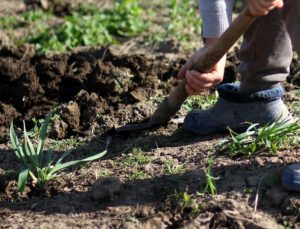
While your soil might be composed of sticky clay with little organic matter, you can create soil with excellent tilth. Rocky soil will require more effort, but the exertion will reward you with beautiful, healthy plants. Choosing the right species—avoiding those that are known to be difficult in your region—makes this task easier.
Slope
Before digging that first hole in the ground, call 8-1-1 to mark underground utilities.
Check the slope. Surface water should always drain away from the house, not toward it, unless you have an elaborate drainage system. You can either build up the soil or create a swale to direct water away from the house. A carpenter’s level and a straight 2 x 4 might help determine the need for greater slope. In average soils, 1″ of slope over 4′ is adequate.
Outline the Bed
According to the landscape plan you’ve drawn, outline the bed with a garden hose or rope. As you proceed, you might decide to enlarge the bed, alter the curve, or continue the planting down the side of the house. That’s fine; you’ll probably make a few changes throughout the process.
A wide, sweeping bed across that part of the house and around the corner provides ample space for the tree and an underplanting. For a more pleasing composition, place the tree diagonally off the corner rather than lined up with a wall. This arrangement, with the garden under it, extends the dimensions of the house. Avoid the temptation to move it closer.
Drive a stake into the ground to mark the tree’s proposed location. If in doubt about the right spot, set the tree there and step back to see how it looks from a distance. Carry the tree by the pot, not by the trunk. Examine the main branching structure, and decide which side of the tree will face front.
Moist soil is easier to dig than dry compacted soil. But don’t dig wet soil because walking on it compresses the air channels and compacts it all over again. It’s best to wait a few days after heavy rain for the soil to drain.
Heavy Clay
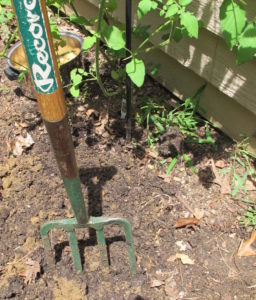
A garden fork.
Remove existing mulch to other gardens or pile it nearby if it’s usable. Remove existing vegetation, such as grass, weeds, and plants you don’t intend to keep.
Shovel the dark topsoil, within 1-2′ of the foundation, away from the house. You’ll see that the top few inches look darker than the soil in lower levels. Higher oxygen levels and organic matter near the soil surface contribute to greater biological activity. The deeper color is from decayed organic matter, or humus, derived from leaves, mulch, and once-living organisms. Reserve the rich topsoil for the bed, where plants will appreciate it.
With a tiller or a sturdy garden fork, start loosening the soil. A round-point shovel works in friable soils, but the fork more easily cuts through heavy clay.
“How Deep?”
Continue digging the soil and breaking up the clods until the top 12-16″ of the bed has been loosened. Where the tree will be planted, you might need to dig deeper than that.
An impervious layer of compacted clay, called hardpan, under the top layers of soil should be broken up with the garden fork. Applying gypsum into the hardpan or annually throughout the garden for several years will help create soil with better tilth and drainage.
If the soil is especially “impossible”, bring in a load of clean, screened topsoil that has been mixed with compost and/or pine fines. Inspect it first or solicit help from a reputable landscaper. Topsoil quality can range between “really good stuff” to “that was a huge mistake”.
While digging the soil, gather some heavy clay and pack it against the foundation about 1-2′ out from it. That fills the void created when you removed the dark topsoil. Don’t cover the siding. Small rocks, under 2″, can be left in the soil, but don’t pile them against the foundation. The large spaces between the rocks attract water, which we don’t want next to the house. And never dispose of them at the base of a tree, either.
Sometimes builders dump roofing shingles, lumber, and other debris near the house. Remove it if you see it. Years ago, the sourwood tree I planted in the front yard stopped growing after the first few years. When digging around the tree, I found a thick layer of discarded shingles which nothing could grow or drain through. Removed. Problem solved.
Existing Plants
For existing shrubs you want to keep, protect the roots from damage while digging near them. If you plan to elevate the bed, you might also have to raise the shrubs, or move them to another location. Their stems and roots should not be buried under added soil. Not an easy task, although elevating the bed above the surrounding surfaces improves the presentation.
If the shrubs are old and not an asset in the garden, remove them.
Headings
Page 1: Are You Ready To Plant Trees?, Native Plants vs. the Non-Natives (The Benefits of Native Species, Native Species and Nativars, Red Leaves and Wildlife, The Untold Story)
Page 2: Deciduous Trees For the Eastern U.S. (The Hollies, The Curious Case of Crape Myrtle, Evergreens), Good Looks, and Before Planting Trees, Soil Preparation For Trees (Slope, Outline the Bed, Heavy Clay, “How Deep?”
Page 3: Adding Amendments, Organic Matter, and Time To Plant Trees (Trees In Pots, B&B Trees, Backfill, Edge, Mulch, And Water)