Page 2
Growing On To Transplant Size
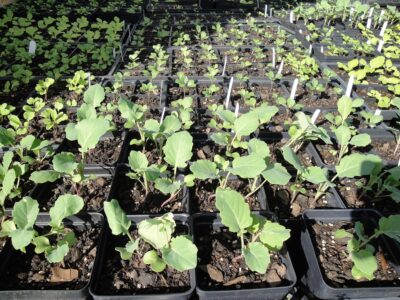
Broccoli, turnip greens, cabbage, and arugula seedlings hardening off next to the porch.
Choose a location where your plants can grow for another 2-3 weeks before they’re planted out. Maybe that’s a sheltered patio or the sunny side of a carport. You might need to take them indoors for the night if it’s too cold.
Check local weather reports, paying close attention to nighttime temperatures. If the cool season greens have been properly hardened off, they shouldn’t be damaged by temperatures around 30°F. After the first week, they’ll tolerate temperatures down to the mid-20’s, and some even lower.
Research the varieties you’re growing. A few cool season vegetables (‘Tokyo Bekana’ Chinese cabbage, mustard greens, tatsoi, pac choi, and Swiss chard) exposed to extended periods of cold weather might bolt (flower prematurely) before reaching full size. Have an old sheet or floating row fabric available to cover them on cold nights. I’d rather plant these crops and take a chance with the weather than let them grow increasingly potbound in their cell packs. Start a backup supply of these crops 1-2 weeks after sowing the first crop.
Soil warmed by the sun lends some protection to plants in the ground. Or you could repot them into 1-2″ larger containers and protect them indoors at night if it’s still too cold.
Alternatively, a caterpillar tunnel or similar clear covering placed over the garden row can protect transplants during a stretch of freezing weather. Vent it in the daytime to prevent overheating. A cold frame helps plants transition to outdoor conditions. Or use one of the floating row fabrics, available in a few weights that offer varying degrees of protection (2-10°).
Good planning includes preparing garden soil so it will be ready to receive your transplants when that moment arrives.
Agricultural extension offices post spreadsheets online that indicate when to plant seeds or transplants into the garden. This guideline for sowing seeds helps keep North Carolina gardeners on track, although we need to heed local weather forecasts. For some crops, you can extend the planting period recommended in the chart. Choosing varieties that are slightly more cold tolerant lets me plant broccoli or lettuce earlier in the season.
Fertilizer
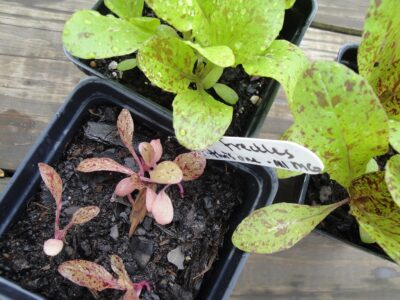
Lack of fertilizer in ‘Freckles’ lettuce compared to 2 pots that were fertilized.
Potting soil normally doesn’t remain fertile for more than 2 or 3 weeks unless timed-release fertilizer is included in the mix. The package’s ingredients label should indicate whether or not fertilizer has been added. To maintain steady growth of seedlings, fertilize with a product formulated for greens or vegetables every 2 weeks starting 2 weeks after germination.
Rain and frequent irrigation rapidly leach nitrogen—the primary nutrient needed for greens—through the soil. Running low in nitrogen stresses plants, and they might not recover when they’re planted. Always keep these seedlings evenly moist, but not wet, to prevent checking their growth. Heavy rain necessitates more frequent fertilization.
From speaking with my customers over the years, it appears that many are hesitant to use any kind of fertilizer on edible plants. Fertilizer is not toxic! Organic sources and chemical (or synthetic) sources of fertilizer break down to the same or similar molecules, and the plant, to a large degree, decides which ones to absorb. Organics add other beneficial nutrients and microbes to the soil.
In cold soil, microbes that break down organic fertilizer into usable forms are not active. So, using a synthetic fertilizer in winter supplies the needed nutrients until the ground warms up. Otherwise, I do prefer organic fertilizers in all the gardens. Used regularly, chemical fertilizer kills microbes and earthworms living in the soil.
Sowing Seeds: The Process
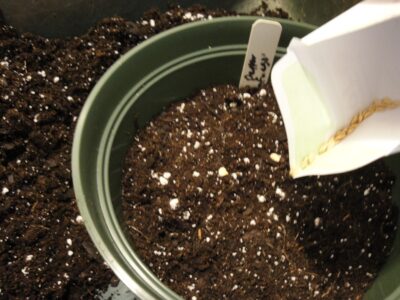
- Read the seed packet for special instructions: temperature, depth, light requirements. Some species need light for germination and some need darkness.
- Fill cell packs or pots with barely dampened seedling mix to ¼-1″ below the rim of the container. Firm lightly and evenly over the surface. You can use fresh, fine-grained potting soil after removing large particles. I use potting soil (sifted through a clean pot with small drainage holes) as a seedbed and to cover the seeds.
- For individual cells in a market pack, make a depression at the depth recommended on the seed packet. For sowing more seeds in a 4″ or a 6″ pot, for separating later, simply level the surface.
- Open the seed packet and pinch the opening to make a V-shaped trough (photo, above). Seeds will be dispersed one or a few at a time with a gentle tap on the packet. Keep the packet dry.
- Sow 1 or 2 seeds per cell. For less waste, drop only 1 seed per cell instead of thinning out later. Refrigerate leftover seeds for subsequent crops.
- Cover the seeds with a small amount of soil. Lettuce is barely covered (needs light to germinate), while arugula and kale are covered with ¼” of soil.
- If sowing seeds in a pot, sow the desired number of seeds evenly over the surface of the soil. Cover with a thin layer of soil. Some seedlings might be weak and culled later, so start a few extra seeds.
- Certain crops (miniature broccoli ‘Happy Rich’, arugula, turnip greens, leaf lettuce) can be sown 2 seeds per cell. For baby lettuce, I sow 4-6 seeds per 3½” pot, spaced evenly around the pot.
- Write the crop and variety name on the label—for example, Arugula ‘Astro’ or Butterhead Lettuce ‘Nancy’. You can add the date of sowing and date of germination, if desired, or record that information in a journal.
- Water gently or place the containers in a solid flat and water from the bottom. Remove excess water from the flat once the surface of the soil feels moist.
- Loosely cover the pots and cell packs with clear plastic film to retain humidity and hasten germination.
- Place the flat where the temperature helps germination. You might need to separate the lettuce pots from the others, since lettuce needs cooler soil, under 70°, to germinate evenly.
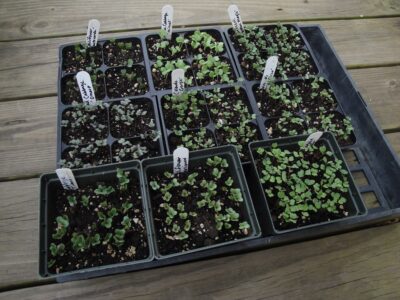
These brassicas germinated in 4 1/2″ pots and cell packs, and then were transplanted individually into cell packs.
Transplanting To Larger Containers
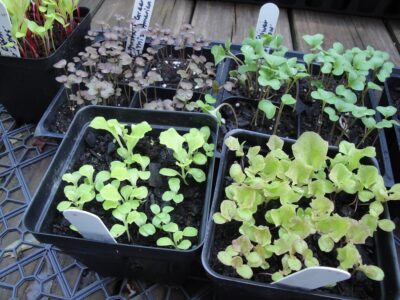
Lettuce and mustard greens.
Within 7 to 14 days of germination, your seedlings will be ready to move into 4-cell packs or small individual pots. I transplant seedlings at an early stage, often with only the seed leaves (cotyledons) showing, before true leaves have started growing.
Waiting much longer causes the roots to become hopelessly entangled if many seeds were sown in pots (photo, above). This could reduce your success rate.
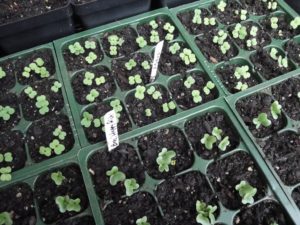
Miniature broccoli ‘Happy Rich’ and arugula ‘Astro’ sown directly into 9-cell packs.
Sowing seeds individually in 4-cell market packs, however, should eliminate one step. These plants can remain in their containers until you’re ready to plant them into the garden or into planters. Don’t wait too long, however, or they’ll become potbound and run out of nutrients.
Plants started in 9-cell packs (photo, above) will be transplanted to 3½” pots and sold a few weeks later at the farmers’ market.
The Process
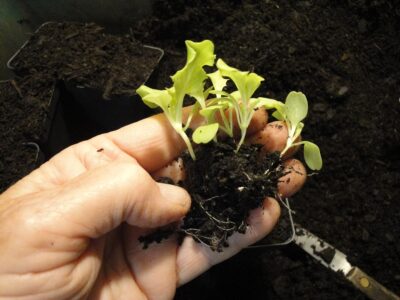
Chinese cabbage ‘Tokyo Bekana’.
- Fill 4-cell packs or small pots almost to the rim with lightly dampened potting soil or seedling mix. Firm it in lightly.
- Insert a knife about 2″ into the soil at the edge of the multi-seeded pot. Lift a few of the seedlings at a time (photo, above).
- Separate the stems from each other, retaining as many roots as possible. Work quickly to avoid drying out the roots.
- Make a hole in the center of the cell to the bottom, using the knife.
- Gently holding one of the seed leaves, lower the seedling into the hole. Very young, healthy seedlings of most crops can root along the stem. So, I bury the seedling’s stem almost up to the seed leaves (photos, below, show a fast-growing blonde cabbage). Add a bit more soil and firm it very lightly against the stem. Be careful not to break the stem.
- Water gently. Place in a flat.
- Move the flat to a place that gets gentle sun. If the seedlings wilt, move them to dappled sun or light shade—outdoors in a protected spot, if possible, with cool to moderate temperatures. I sometimes use a mesh flat to lightly shade new transplants. Avoid harsh direct sun, wind, and temperature extremes while the roots recover. Small seedlings are less likely to wilt than larger seedlings.
- Once the seedlings have stabilized in 2-3 days, give them full sunshine. The sooner they acclimate to proper growing conditions, the stronger the plants will be.
-
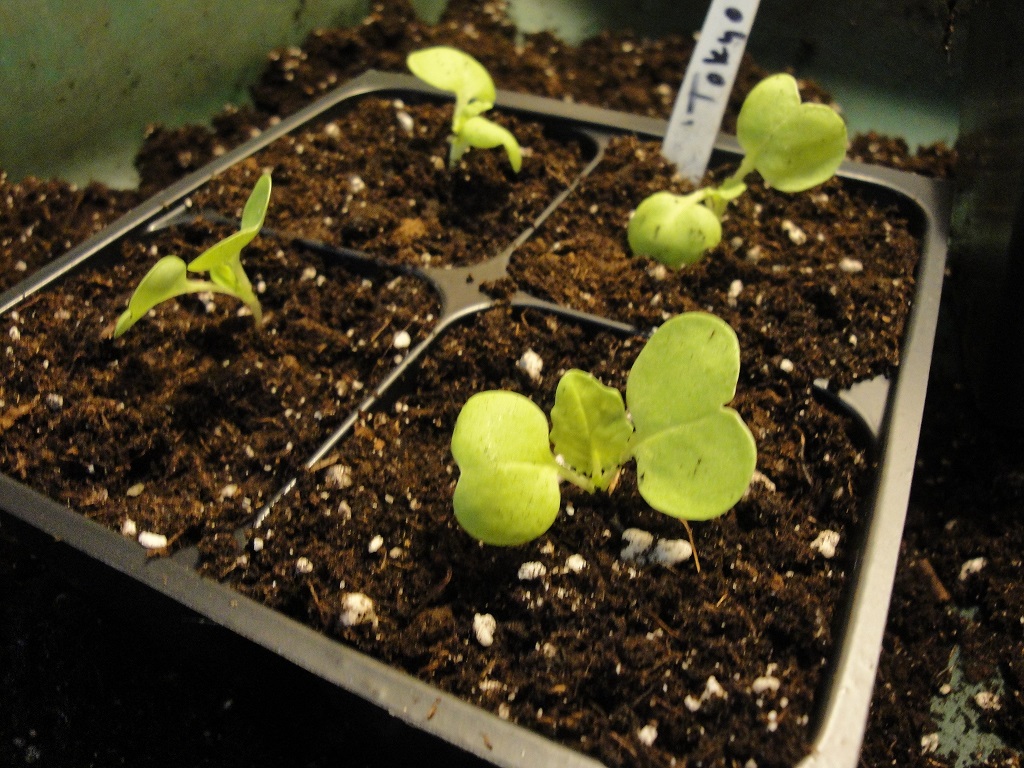
- …transplanted deeper into the cell pack.
-
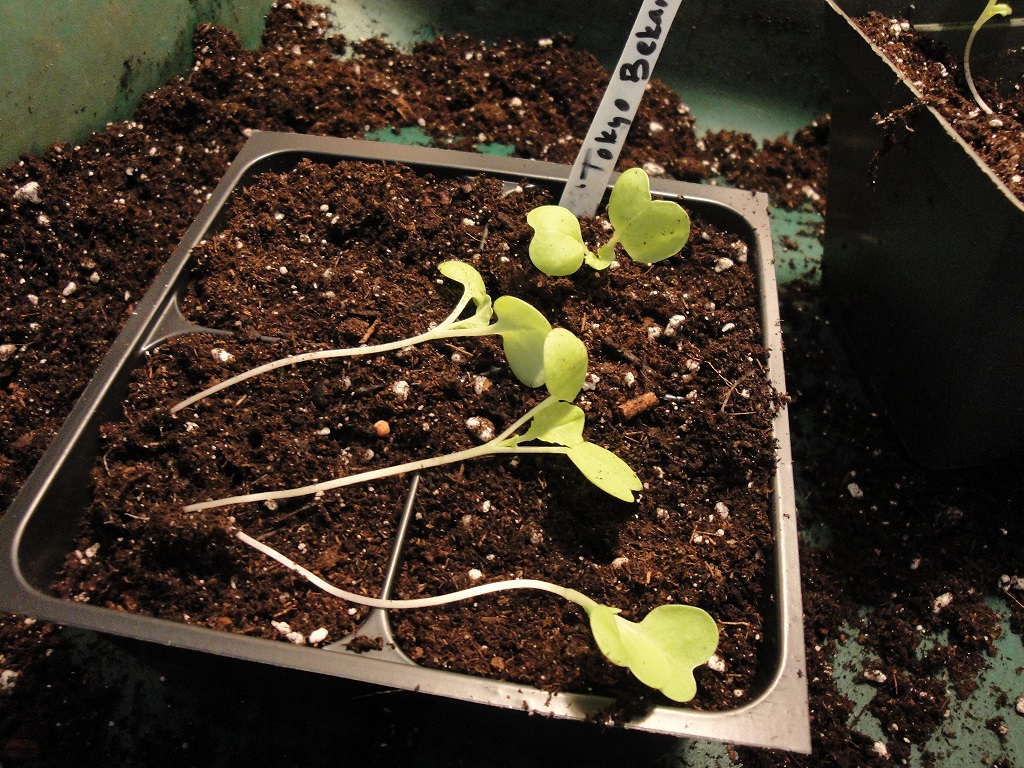
- Overgrown ‘Tokyo Bekana’ Chinese cabbage seedlings…
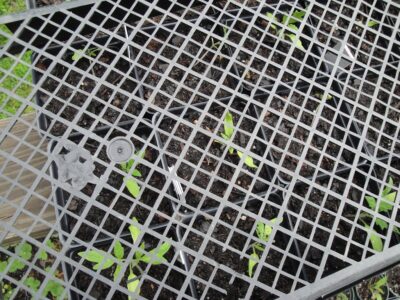
New tomato transplants protected from strong sun for a day or two with a mesh flat.
Sowing Seeds And Transplanting In Multiples
I often transplant seedlings into 3½”, 4½”, and 6″ pots. Some customers prefer the larger pots because the plants are bigger and have more extensive root systems. Planting more mature plants hurries the harvest.
For miniature broccoli ‘Happy Rich’ (photo, below), arugula ‘Astro’, or turnip greens, I transplant 2 seedlings into the pot instead of planting them singly. This works for certain varieties, but not for crops that develop one main head.
Parsley (a cool tolerant biennial herb), leaf lettuce, mesclun, and peas are additional crops with seeds sown in multiples (photos, below).
-
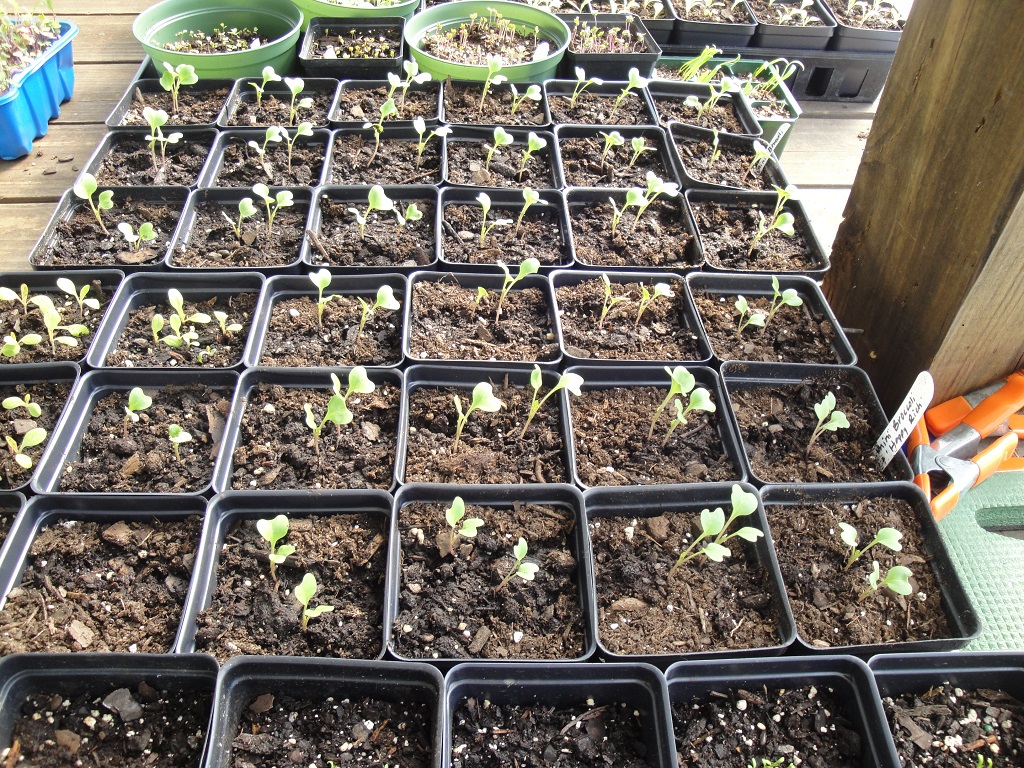
- Miniature broccoli ‘Happy Rich’, 2 seedlings per pot.
-
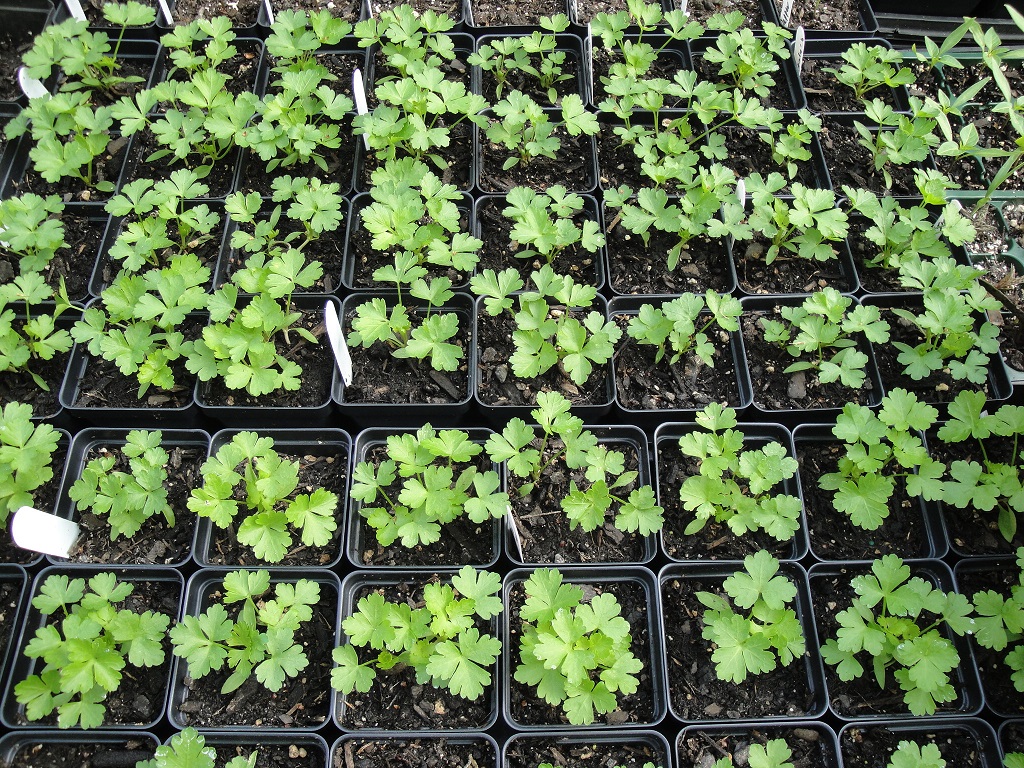
- Flat-leaf parsley, 3-5 seeds per pot.
-
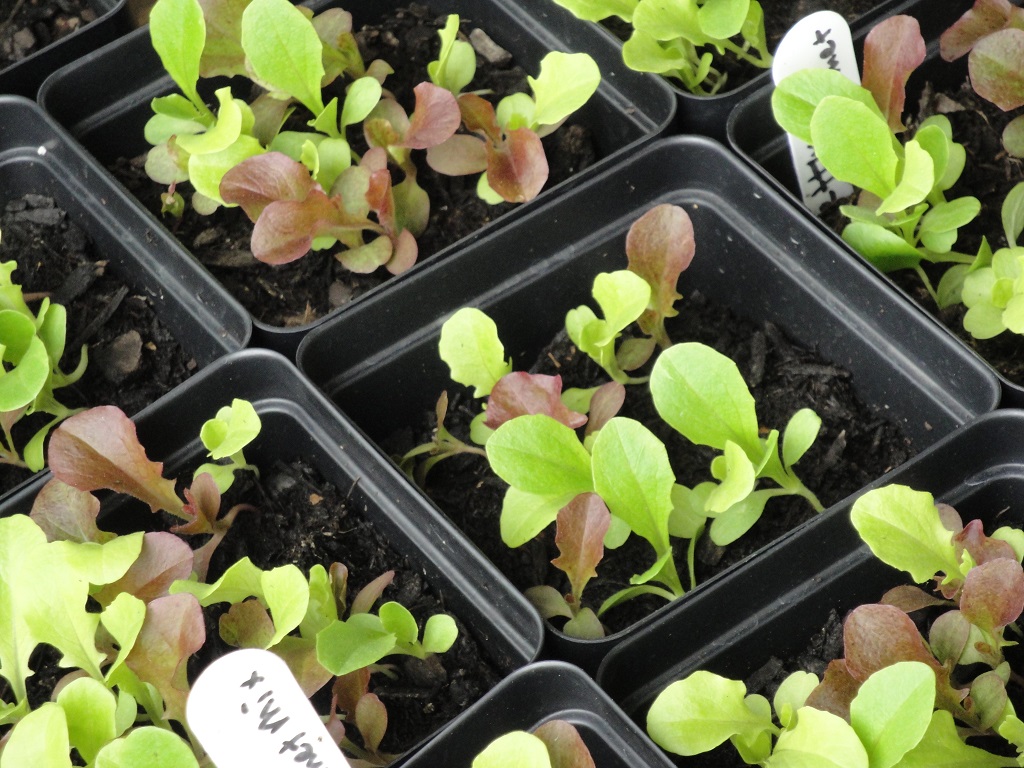
- Allstar Gourmet lettuce mix seedlings for baby leaf clippings.
-
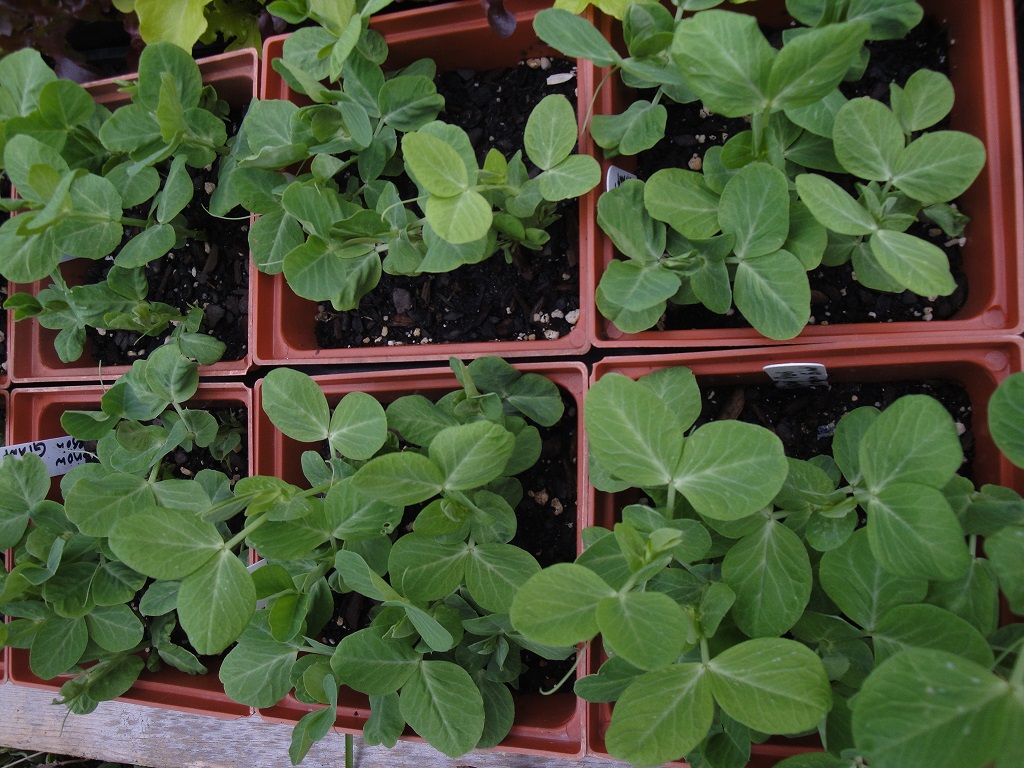
- ‘Sugar Snap’ peas in 6″ pots, about 6 seeds per pot.
After 2-4 weeks of growing in these pots, they’re ready to transplant to their final location in the garden. The weather can be quite unsettled in early spring, so pay attention to the forecast. Have some old sheets or a caterpillar tunnel ready to cover recent transplants when the temperature plummets below 25° or if torrential rain threatens.
Each week, we get closer to those beautiful mild spring days… and short-sleeved shirts… and the first harvests. I hope you find growing these early crops as rewarding as I do. One success builds on another, and before you know it, you, too, will look forward to sowing seeds before the daffodils bloom.
Headings:
Page 1: Sowing Seeds For The First Crops: Too Early? (When, Exactly?, Summer Broccoli?, “How do I use these greens?”, Why brassicas are my favorite vegetables…), Preparing To Sow Seeds (Temperature For Sowing Seeds, Miniature Incandescent Christmas Lights, Preparing Pots For Sowing Seeds, Light For Germinating Seeds, In My Basement, Natural Sunlight And Temperature, How Low Can They Go?, One Step At A Time)
Page 2: Growing On To Transplant Size (Fertilizer), Sowing Seeds: The Process, Transplanting Into Larger Containers (The Process, Sowing Seeds and Transplanting In Multiples)
Depending on where you live, you can start cool season greens in mid-winter, late winter, or early spring. Variety selection is important. For example, broccoli ‘Green Magic’, ‘Monty’, and ‘Belstar’ are good options for spring crops, forming heads in warming weather. ‘Arcadia’ and ‘Marathon’ are good as fall crops, in cooling weather. I always grow ‘Arcadia’ in autumn because it’s the most cold-tolerant broccoli I’ve grown (often lasting all winter here in zone 7b) and it produces many rounds of side shoots after the main head has been harvested. Spinach and lettuce are other crops that have cultivars that tolerate varying amounts of frost/freezing or warm temperatures.
Arugula ‘Astro’ is my favorite variety because it can take warm or cold conditions and it self-seeds prolifically. That’s one of the earliest greens I start. At the same time, I sow seeds for miniature broccoli ‘Happy Rich’, spinach ‘Lizard’, bunching onion ‘Nabechan’, the tender kales ‘Red Russian’ and ‘Lacinato’, and some of the lettuces. After being transplanted into cell packs or individual pots, they go out to the enclosed porch or outside in moderately cool sunshine. During those late winter/early spring months, the flats might have to come back into the porch at night until the weather moderates.
Contact Johnny’s Selected Seeds and request a print catalog. There’s a lot of helpful information about growing each crop, including cold tolerance. Experience with each variety will teach you which varieties can tolerate colder temperatures and how far you can push the envelope. Keep notes!
Kim
Early sowing is a game-changer! What’s the earliest crop you confidently recommend starting in late winter?