Page 2
What can we grow in a cool season garden?
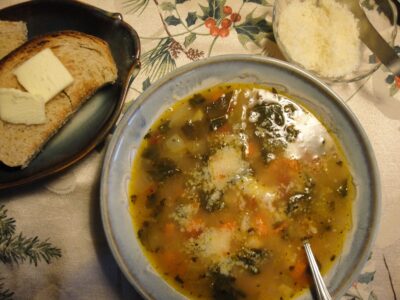
Mmm…collards soup!
Herbs and Vegetables
Regardless of weather—yes, year-round—there’s something growing in my gardens. I’ve done this for many years and never let cold weather get in the way. What could be more satisfying than picking fresh kale, spinach, and a green onion for the Sunday morning veggie omelet…in January? You could add a ripe ‘Lunchbox’ or ‘Aura’ sweet pepper from that potted pepper growing in front of the sunny patio door.
- Picking herbs and collards for homemade soup…
- green onions, broccoli, and a carrot added to a quick stir-fry…
- spinach and other greens for homemade chicken soup…
- a handful of arugula for the pizza or tomato sauce…
- and several greens and vegetables, in addition to lettuce, for a big dinner salad…
…it’s all right there, a short walk out the back door—fresh, flavorful, and pesticide-free!
Once you begin adding fresh herbs and greens in your cooking, it becomes easier to find more ways to use them. This is how we develop a routine for healthy eating that lasts a lifetime. (Check with your doctor if you have dietary considerations.) With autumn weather approaching, now is a great time to give cool season gardening a try!
If it’s too late to start seeds for your garden, you can buy some time by purchasing transplants from your local farmers’ market or garden center.
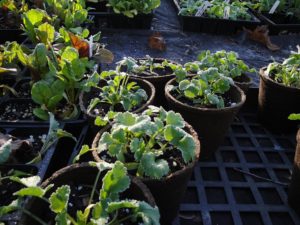
Frosted cilantro ‘Cruiser’.
Herbs That Tolerate Cool to Cold Weather
Parsley is a biennial, surviving winter in USDA zones 3-10. (Biennials germinate the first year, overwinter outdoors, flower the next year after exposure to cool/cold temperatures, set seed, and then die.) Harvest leaves the first year, in winter, and the next spring. As parsley matures in its second season, though, the leaves can become a bit tougher and more strongly flavored. Cutting celery, for strong celery flavor, grows the same way, but larger.
I usually let parsley flower in the garden for the pollinators before removing it. Honey bees (Apis mellifera) and other pollinators love members of the Apiaceae family, which includes parsley, celery, cilantro, dill, lovage, carrots, fennel, and chervil.
Cilantro (photo, above) is a short-lived annual when grown in summer. But a young plant settled into the autumn garden often survives the entire winter for clippings in autumn, winter, and spring. It goes to flower with warming temperatures in spring and then dies. In regions colder than mine, some protection will be needed for cool season harvests. I’ve had the best results—particularly in warm temperatures—with the varieties ‘Cruiser’ and ‘Calypso’.
Dill tolerates light frost, and sometimes hard freezes. But it won’t last all winter here. My favorites are the dwarf ‘Fernleaf’ and the medium-sized ‘Teddy’. If starting seeds, don’t be disappointed if very young leaves lack strong flavor; that will develop in time.
Italian oregano, chives, dwarf winter savory, French sorrel, French tarragon, lemon balm, and mint die down to the ground in this climate, although some ground-hugging stems and foliage might survive the winter.
Thyme, lavender, sage, and rosemary keep some or most of their leaves through the winter, but they lose more foliage in severe winters. Cold, wet soil can shorten their lives. Add drainage material throughout the soil profile to improve drainage. Plant them in a warmer microclimate if you live where they’re not very hardy.
Basil
Basil declines—then dies—with cooling temperatures, often before frost comes along. This is the herb that’s most sensitive to low temperatures, preferring to stay above 68° indoors.
I keep a few small potted basil plants growing indoors in the winter. The pots sit on the kitchen counter, in front of the sunny windows. Because the house cools to the high 50’s on winter nights, I move the potted basils to the top of the 78° aquarium, also in the kitchen. This keeps the soil temperature around 70° at night. In the morning, they go back to the sun.
When healthy plants get plentiful direct sunlight, they can tolerate other conditions that are just outside their comfort zone. So, healthy basil getting great sunlight in the daytime can take cooler temperatures than the 68° they prefer…within reason.
My favorite basils for indoor growing include:
- the tiny-leaved miniature ‘Pluto’ (leaves and small tender stems are edible)
- the strongly flavored dwarf Greek basil called ‘Yevani’
- ‘Genovese Compact’
- and sometimes Thai basil (‘Siam Queen’) for herbed salmon
Fresh leafy herbs—especially basil—have better flavor than dried herbs. Still, I dry many herbs in case fresh foliage isn’t available. Frozen parsley, although wilted, keeps good flavor for soups and sauces. I always dry enough ‘Siam Queen’ basil, dill, and other herbs for winter use, and they retain good flavor.
Cool Season Gardening in the Enclosed Porch
More Herbs
‘Compactum’ marjoram, Mexican mint marigold, and bay laurel are hardy to USDA zone 8, where it’s 5-10° warmer than our 7b average winter low temperatures. These herbs come into the sunny enclosed porch for winter growing. Because they stay in pots year-round, hard freezes outside could kill these plants. Their roots are not insulated by surrounding garden soil, so potted plants feel as though they’re growing where it’s 1-2 climate zones colder.
It’s chilly in the porch on winter nights, but rarely frosty. If nighttime temperatures fall into the single digits outside the porch, however, the marjoram and the bay laurel come into the house “just in case”. I don’t want to lose them!
Potted Vegetables
Potted greens (lettuce, green onions, Swiss chard, assorted brassicas) are moved from outside into the porch on very cold nights (below 15°) so they can continue producing harvests. But they’re returned outside the next morning, after the sun warms the area.
Sometimes, I just throw a large sheet and a pile of oak leaves over them for the night and keep them outside. Garden centers and online retailers sell products (floating row fabric, frost blankets, tarps) designed for this purpose. The front of the sunny porch provides a mild microclimate for potted vegetables. There, the nighttime temperature stays 3-7° warmer than out in the open.
For the past 2 years, I’ve kept 10″ pots of ‘Sugar Snap’ peas, and they produced enough pods to make it worthwhile. The self-pollinating peas were not moved outside, but stayed on the porch…trying to twine around the Christmas lights hung higher up.
For late 2024, the National Weather Service predicted a greater likelihood of colder than normal weather, so I stapled a second layer of clear greenhouse film inside the porch. It’s the dead air space between the 2 layers of plastic that provides additional insulation. This arrangement was very satisfactory, and has become part of the annual winterizing routine. By mid-spring, both layers of the film are removed, cleaned, and stored for the next season.
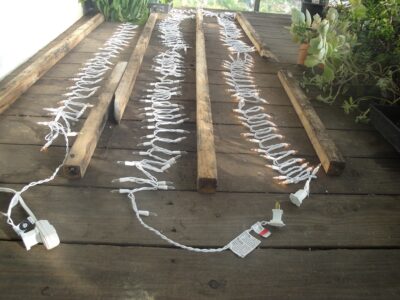
Flats of plants will sit on the 2×2’s, above 3 strings of mini lights on each side of the porch.
Succulents and Young Tomatoes
Succulents and several other houseplants kept inside the porch receive gentle bottom warmth from indoor/outdoor miniature incandescent Christmas lights (photo, above). On cold nights, a plastic bubble (1-2 layers), old sheets, and light blankets cover the tender plants and hold warmth close to their foliage. When morning sun warms the space, all covers are moved to the side.
(***Update***: Temperature readings outside and inside the enclosed porch:
- December 10, 2025, mostly cloudy at 8:20 a.m., outside temperature=31°, inside and halfway up the porch post=42°, under the bubble=49°.
- One hour later, with lights off: outside=35°, post=49°, bubble=52°. Bubble removed after the reading.
- January 19, 2026, 8:30 a.m., after below average temperatures for a few days and nights, and only 2 hours of direct sun in late afternoon the day before, outside=24°, post=38°, bubble=48°.)
If Christmas lights burn out, I hook up the seedling heat mats. They put out quite a bit of warmth, but are not thermostatically controlled. They consume more electricity than the increasingly less reliable and short-lived mini lights.
In March, with mini lights functioning for hundreds of succulents, I inverted webbed flats on the heat mats before placing the first crop of tomatoes on top of them. This prevented overheated soil and better distribution of the warmth. A layer of plastic over the tomatoes retained warmth close to the plants. As long as they stayed above 48°, this saved me the trouble of moving the first 20 flats of tomatoes indoors every night. For heat mats and cables, check to see if they’re water-safe.
The earliest cool season crops sown indoors in mid-winter harden off here (photo, below) in late winter. Unlike the succulents and the first tomatoes, they are not covered at night, but receive enough protection just being inside the enclosed porch.
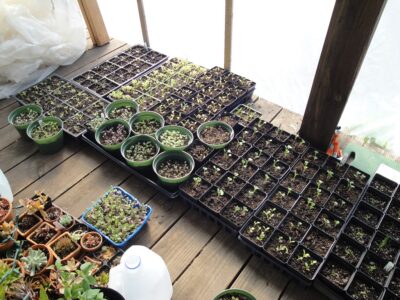
The first crop of cool season greens, as seedlings in February, with succulents snuggled closer to the house wall.
The Brassicas for Cool Season Gardening
My favorite varieties of edibles are the brassicas. They’re members of the Brassicaceae family (formerly Cruciferae), also known as cruciferous vegetables or cole crops. Because they contain very high levels of vitamins, minerals, fiber, and phytonutrients, they’ve earned the name, “superfoods”. There’s more on this topic at the end of Page 3.
Brassicas are versatile in the kitchen. Derived from only a couple of species of plants (Brassica oleracea and B. rapa), the myriad forms and cultivars appeal to many tastes and methods of preparation. They include:
- arugula—‘Astro’ is not as hot as other varieties, self-seeds (salad types are Eruca sativa, not a Brassica species, but it’s still classified as a cruciferous vegetable)
- broccoli and miniature broccoli
- Brussels sprouts
- cabbage, Chinese cabbage
- cauliflower
- collards
- gai lan, or Kaillaan, Chinese broccoli
- kale—I like the tender-leaved ‘Red Russian’ and ‘Lacinato’ types; others prefer the curly kales
- kohlrabi
- mizuna
- mustard greens
- pac choi
- radish
- tatsoi
- turnip greens
Some are used raw in salads, sandwiches, smoothies, cole slaw, and Brussels sprouts slaw. Others are lightly cooked as side dishes or used in stir-fries, pasta dishes, veggie omelets, and pizza. I sometimes add mustard greens and arugula to sandwiches. Brassica greens add nutrients and flavor to soups and sauces, including those bought ready-made from the grocery store.
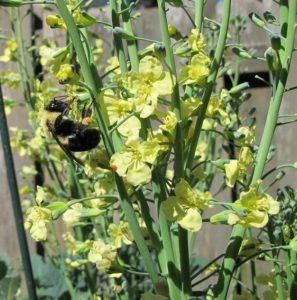
A bumble bee on ‘Arcadia’ broccoli, April.
The brassicas love cool to cold weather, and, in fact, often taste sweeter in frosty temperatures. That’s because the plant transforms starches within its cells into sugars and protective proteins, which act as an antifreeze. It’s not until the temperature exceeds the plants’ lowest tolerance that they finally die. On the other hand, some are so hardy that they survive winter until they, as biennials, go to flower the next spring. Bees and other pollinators appreciate this early source of sustenance.
Certain types of cole crops survive temperatures down into the low teens F. Those include arugula, Brussels sprouts, collards, miniature broccoli ‘Happy Rich’, and kale. Other brassicas—such as cabbage, cauliflower, and pac choi—prefer milder weather, although they can tolerate a few to several hard freezes. With a sharply cold wind, though, these greens will succumb unless they’ve been covered.
Broccoli
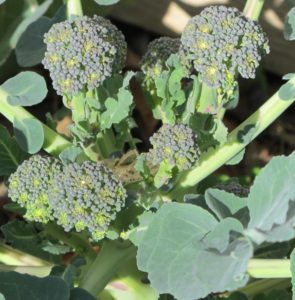
Broccoli ‘Arcadia’ side shoots.
Depending on the cultivar of any of those crops you choose to grow, some might die in a hard freeze while others survive it. This is where a little experimentation in your garden, year after year, clarifies the differences between cultivars. Keep the labels and good notes!
When selecting varieties of crops to grow, find out which broccoli, for example, prefers heading up in moderate weather and which in cold weather.
For the first fall broccoli crop, try ‘Green Magic’ or ‘Monty’, which develops heads in early to mid autumn. Depending on the weather, it might produce a round or two of side shoots. ‘Imperial’, ‘Gypsy’, and ‘Amadeus’ are other varieties for planting at this time. These are the varieties planted again in late winter/early spring.
Where late summer’s high heat lingers, you might need to provide some relief with 30-40% shade cloth or an old sheer curtain elevated above the plants until temperatures moderate. Sometimes, a brief splash of cool water is all they need.
A later crop of ‘Kariba’, ‘Marathon’, or ‘Arcadia’ broccoli can last through colder weather—even through winter in this zone 7b climate—producing first the main head and then several crops of side shoots.
I’ve grown ‘Arcadia’ for many years as a mid-autumn to winter crop for the numerous rounds of side shoots it produces. In the Charlotte garden, we harvested side shoots all the way through winter, with only a few instances when I needed to loosely cover the plants, and into spring.
This is why variety selection helps gardeners get more mileage out of the season. A good seed catalog, such as the one from Johnny’s Selected Seeds, lists many cultivars of each crop. It specifies in several charts and with hot/cold symbols which varieties can tolerate hotter or colder weather. This helps me decide which cultivars of a particular crop to plant in any given month.
Variety or Cultivar?
On the issue of calling plants “varieties” or “cultivars”: for convenience, the terms are used interchangeably. Taxonomists use the term “variety” to describe the form of a plant that might be slightly different from the species. They “breed true” in the next generation; their offspring usually look like the parent plant. The naturally occurring pink and red forms of the native white flowering dogwood (Cornus florida) are two examples.
“Cultivar” is a shortened version of “cultivated variety”, meaning it was created by hybridizing 2 particular parent plants; it is unlikely to breed true.
Green Onions and Bunching Onions
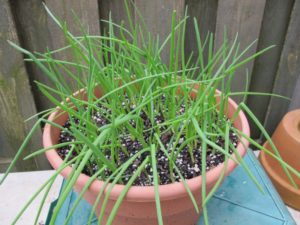
Green onions for winter.
Onion sets planted in a pot or into the garden can yield green onions (photo, above) in a short period of time—just a few weeks—during cool to moderate weather. This is a very easy crop to grow.
Onion sets are immature onion bulbs, planted about 2″ deep. Left in the soil long enough, these young green onions will develop bigger bulbs, which can be pulled at any time. The larger the bulb, though, the more difficult it will be to pull a green onion in one piece.
If you want to harvest young green onions, grow them quickly and harvest the entire plant when it has developed the familiar green leaves. These green onions are members of the species, Allium cepa.
Depending on your latitude, short-, intermediate-, or long-day cultivars work best. Day length triggers bulb formation. Gardeners in the South grow short-day varieties for mature onion bulbs. Here in the northern tier of the South, we can grow short-day and intermediate-day varieties. In the northern U.S., long-day varieties are recommended. But for green onions, any of the onion sets will work since the plants are picked before bulbing.
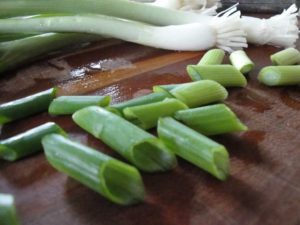
Bunching onions.
For sustainable bunching onions, in the species Allium fistulosum, start seeds. Bunching onions, or scallions, don’t make bulbs, so they’re not available as onion sets. Seedlings are quite delicate and require special handling to develop that long, white straight stem. Or buy a bundle of “green onions” (they’re usually bunching onions) at the grocery store or farmers’ market, and save the bottom 1/2″, with roots (photo, below), for potting up.
Every autumn, I grow a few dozen plants in a 12″ pot, and grow them all winter long. When the temperature plummets, they stop growing, so I move the pot into the enclosed porch for the night when the thermometer reads lower than 20°F. However, simply placing the pot outside but in front of the sunny porch—in a warm microclimate—suffices through most of the winter.
Piling leaves or mulch around the pot and over the foliage insulates the plants. Although onions tolerate cold temperatures, repeated exposure to deeply freezing temperatures turns the onions to mush.
For Sustainable Bunching Onions
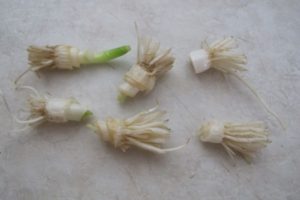
Cut stems sprout in a few days.
Here’s the sustainable part: If you cut the plant 1/2″ above the bottom of the white part of the stem, the roots and crown (where roots meet stem) will grow another bunching onion, over and over again. That’s because of the location of the growing point (an intercalary meristem), which is a thin layer of cells in the crown. From that point, the meristem pushes up new growth, just as grass blades and daylily leaves grow from the base of the plant.
It takes good aim with a small knife to find that spot above the crown, but not to worry: if you harvest the whole plant, cut the bottom 1/2″ off the stem and replant it 2″ deep. Roots and crowns left in the soil produce new shoots faster than those that were entirely removed.
By adding ½-1″ of potting soil around healthy stems every 2-3 weeks, bunching onions and green onions (leeks, too) develop longer and thicker white “blanched” stems. This sounds contrary to good gardening advice, but they’ll survive, given good sunlight and moderately cool temperatures. The lowest leaf will turn brown as new leaves grow from the center. Fertilize every few weeks with fish emulsion.
Don’t keep onions too wet; this rots the parts underground. During periods of frequent rainstorms, place the pot under cover to prevent the soil from staying saturated.
Sometimes, I’ll harvest just one green leaf for a salad or a veggie omelet, leaving the rest of the onion undisturbed. Older plants grow thicker and eventually flower, so cut those stems 1/2″ above the crown to refresh the growth.
The flower is a cluster of tiny bulbs which can be planted. Most scallions are not hybrids, so the offspring will be identical to the parent plant.
Spinach
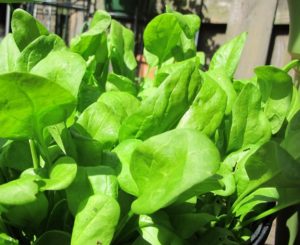
Spinach ‘Monstrueux de Viroflay’ in a 12″ pot.
I’ve grown ‘Lizard’ spinach the past few seasons, and was pleased with its longevity without bolting. Spinach seeds are sown indoors because they don’t germinate well at soil temperatures over 70-75°F. After germination, it can safely be moved outdoors for autumn and early winter harvests.
The next crop of spinach will be ‘Sunangel’, a new variety for me this year. The seed catalog states it can be grown all year. We’ll see how long it lasts this autumn, and how new sowings next spring hold up in summer heat. ‘Space’, ‘Kolibri’, and ‘Regiment’ also might last into winter. (***Update***: ‘Sunangel’ suffered no damage this winter, even through an unusually cold period this past week. 1/19/2026. Summer, however, was extremely hot and the few plants I had did not thrive. 9/2/2026)
‘Monstrueux de Viroflay’, also called ‘Viroflay’ or ‘Monster’, is a French heirloom dating back to 1866. It has significantly larger leaves, somewhat lower oxalate levels, and can last all winter here. I’ll grow this one in a 12″ pot (photo, above), and move it around to follow the sun or to protect it from severe temperatures.
Headings
Page 1: Today, In the Garden (Dealing with Frost, Covering Crops with Plastic or Old Sheets, Potted Plants for Growing Indoors, Moving Houseplants Indoors), Shopping Your Local Farmers’ Market (Supporting Your Local Economy)
Page 2: What can we grow in a cool season garden? (Herbs and Vegetables, Herbs That Tolerate Cool to Cold Weather, Basil, Cool Season Gardening in the Enclosed Porch, More Herbs, Potted Vegetables, Succulents and Young Tomatoes, The Brassicas for Cool Season Gardening, Broccoli, Variety or Cultivar?, Green Onions and Bunching Onions, For Sustainable Bunching Onions, Spinach)
Page 3: More Greens for Cool Season Gardening (The Lettuces, My Lettuce Favorites, Swiss Chard, What else can we expect from cool season gardening?, Soil Prep, Caterpillars and Aphids), Structures for Cool Season Gardening (The Greenhouse), A Note About Brassicas and Their Antioxidants